ROLE 01
Author
I created this content.
Signature at creation time. The most common role. Engages the responsibility of whoever produced the content, its editorial intent, and its origin.
The protocol
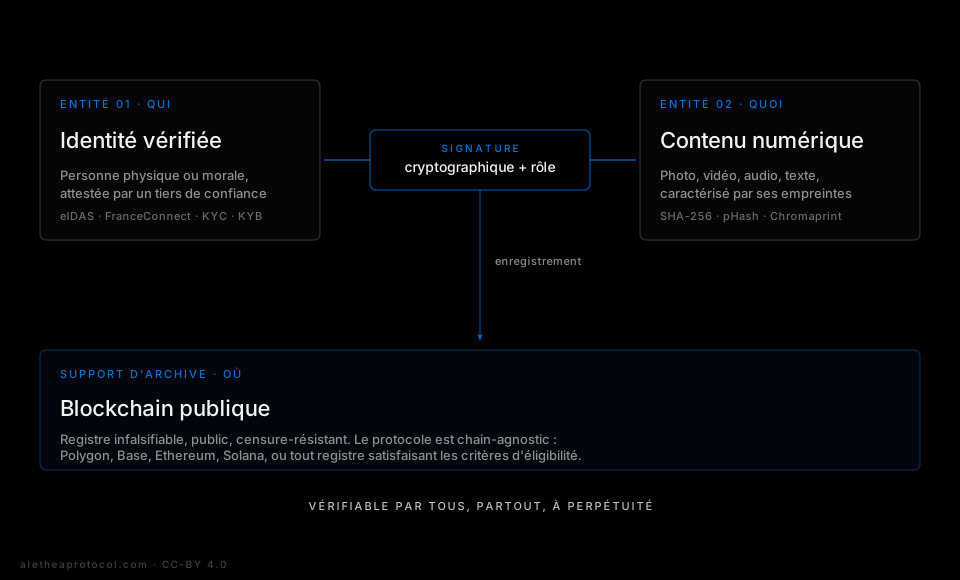
How Alethea ties together verified identity, content fingerprints, graduated signatures, and a tamper-proof registry. For the full detail, see the specifications.
A file can be cryptographically signed without engaging any verified human identity. That is the case with most current solutions: technical provenance, yes, but behind which human, which status, which responsibility?
Signature alone documents the tool and the moment. It says nothing about the author. AI detection chases a moving target. AI watermarks cover a subset. None of these approaches bind a verified human identity to a piece of digital content in a tamper-proof way.
Alethea adds the missing link — not by replacing existing standards, but by stacking on top of them.
Two entities, one signature linking them, one tamper-proof registry as the archive layer. That's it.
Signing a piece of content is not just saying "I saw it". It is stating what you are in relation to it. Alethea defines five distinct roles, each engaging a different responsibility.
ROLE 01
I created this content.
Signature at creation time. The most common role. Engages the responsibility of whoever produced the content, its editorial intent, and its origin.
ROLE 02
I appear in this content and confirm its authenticity.
For someone visible or audible in the content. Lets the subject confirm that it is really them, that they stand behind what they say, and that they have not been remixed against their will.
ROLE 03
I was present at the event and certify it.
For someone who is neither the author nor a visible actor, but who can attest to what was filmed or photographed. Important for journalism and event coverage.
ROLE 04
I relay this content and take responsibility for the editorial choice.
For a media outlet, a platform, or a high-audience account that rebroadcasts. Engages editorial responsibility for the relay, not authorship.
ROLE 05
This content depicts me and I contest it.
Our main conceptual contribution. Lets a verified identity sign existing content after the fact to refute it, with context and explanation. Via perceptual fingerprints, the rebuttal automatically propagates to every derivative version.
Reclaim
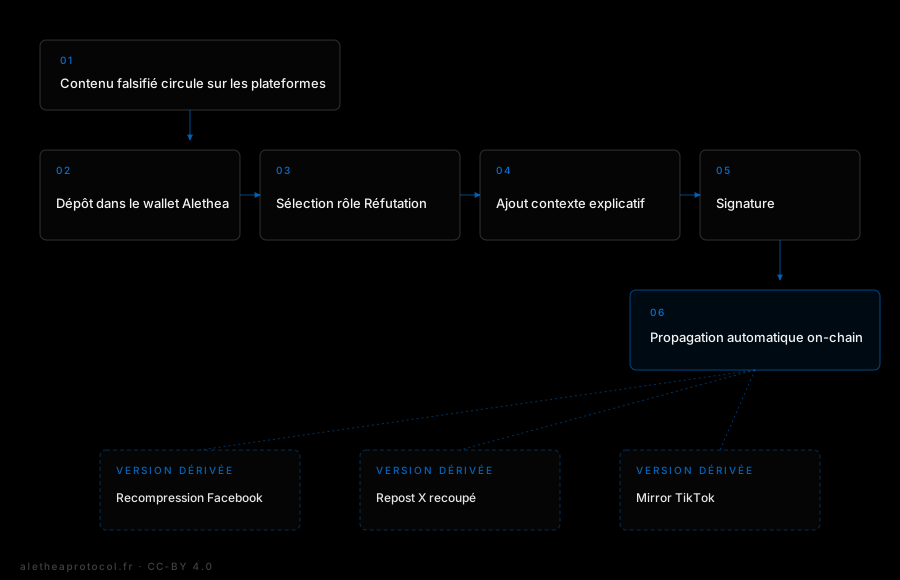
Where other approaches only sign at creation, Alethea lets a verified identity sign existing content to refute it. The signer deposits the falsified version in their Alethea wallet, selects the Reclaim role, adds the explanatory context, and signs.
The rebuttal is tamper-proof, timestamped, and public. Thanks to perceptual fingerprints, any derivative of the refuted content — recompressed, recut, reposted on other platforms — automatically triggers the rebuttal display.
The rebuttal propagates at the speed of the fake, across every platform, without needing the platforms' agreement. This is a new asymmetry that makes disinformation costly for those who knowingly spread it — up to possible legal consequences in many jurisdictions (in France, article 226-8 of the Penal Code on image-altering montage carries up to two years imprisonment and a €45,000 fine; similar provisions exist in most national legal frameworks).
The protocol is structured in independent layers, like the TCP/IP stack. Each layer can evolve or be swapped out without breaking the others.
L4 — Application
User wallets, browser plugins, newsroom integrations.
L3 — Verification
Multi-fingerprint matching algorithm, conflict resolution, C2PA interoperability.
L2 — Signature
ECDSA secp256k1 or Ed25519, canonical signature format, JSON-LD encoding.
L1 — Identity
Accepted external standards: eIDAS substantial/high, NIST 800-63 IAL2/IAL3, ISO 29115 level 3+. No anonymous signers.
L0 — Registry
Chain-agnostic layer. Per-chain profiles (Polygon, Base, Ethereum, etc.). Minimal smart contract.
Alethea does not replace existing protocols, it stacks on top of them. Here is a concise position relative to the three dominant approach families.
vs AI detection
Detectors are running a technological race they cannot win. Alethea changes the question: instead of asking whether content is AI-generated, we ask whether a verified identity takes responsibility for it.
vs C2PA
C2PA is an excellent technical provenance standard. Alethea is complementary: C2PA answers "which tool produced this file"; Alethea answers "which verified identity takes responsibility for this content". An Alethea signature can be embedded in a C2PA manifest.
vs Numbers Protocol
Numbers accepts an anonymous wallet as signer. Alethea does not accept anonymous signers, full stop. The protocol normatively requires identity verification compliant with an international standard (eIDAS substantial+, NIST IAL2+, or ISO 29115 level 3+). Anonymous signing is a functional flaw, not a feature.
| Capability | Alethea | C2PA | Numbers | SynthID |
|---|---|---|---|---|
| Binds verified human identity to content | ✓ | ✗ | ◐ | ✗ |
| Cryptographic signature on content | ✓ | ✓ | ✓ | ✗ |
| Tamper-proof public registry | ✓ | ✗ | ✓ | ✗ |
| Anonymous signing rejected normatively | ✓ | — | ✗ | — |
| Post-hoc refutation (Reclaim) | ✓ | ✗ | ✗ | ✗ |
| Chain-agnostic registry | ✓ | — | ✗ | — |
| Open spec, royalty-free | ✓ | ✓ | ✓ | ✗ |
| Survives recompression / re-encode | ✓ | ◐ | ◐ | ◐ |
| Works on existing content (not only new) | ✓ | ✗ | ◐ | ✗ |
Legend: ✓ supported. ◐ partial or optional. ✗ not supported. — not applicable.