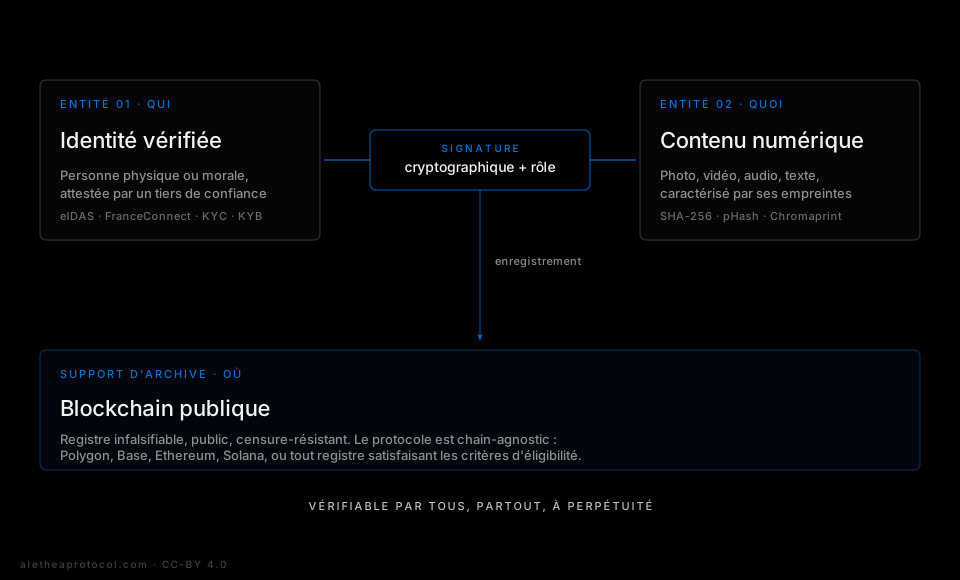
ENTITY 01 · WHO
Verified identity
A person or an organization, whose identity is verified against a recognized international standard. The identity stays private. Only a hash lands on the registry.
The protocol for digital trust
Alethea binds a verified identity to digital content through a public, tamper-proof registry. An open, neutral trust layer, built to belong to everyone.
The protocol
The protocol fits in one sentence. A verified identity and digital content, linked by a cryptographic signature, recorded on a public blockchain. Everything else is implementation.
ENTITY 01 · WHO
A person or an organization, whose identity is verified against a recognized international standard. The identity stays private. Only a hash lands on the registry.
ENTITY 02 · WHAT
Any published content, fingerprinted client-side with several algorithms. The content never leaves the publisher. The protocol never sees it.
SIGNATURE
A cryptographic signature binds identity to content, with a graduated role: author, actor, witness, broadcaster, reclaim. This is what the protocol defines.
ARCHIVE LAYER · WHERE
The signed link is recorded on a public blockchain. The protocol does not depend on any specific chain. Several profiles can coexist.
The reality
AI-generated misinformation now scales faster than humans can debunk it. Detectors are losing a race they can't win. Signature alone isn't enough either. The missing link: a tamper-proof binding between a verified identity and the content itself.
1,250+1
AI-generated misinformation sites tracked online
0.1%2
of users reliably spot a deepfake video
$40B3
projected US deepfake fraud losses by 2027
20244
AI misinformation sites first outnumbered traditional ones
Vision
Like HTTPS for web communications, like C2PA for technical provenance, Alethea is the missing layer: binding verified identity to digital content, on a registry no one can censor.
The ambition is plain. Adoption by platforms. Integration in newsrooms. Recognition by legislators. Eventually, making content signing a requirement for anyone publicly responsible for what they say.
The name
In Ancient Greek, alḗtheia means unconcealment, the truth that comes out of hiding. The word is built as a- (un-) plus lḗthē (oblivion, the mythological river that erases memory).
Literally: that which cannot be forgotten.
A protocol that records what is signed, forever, on a public ledger, carries that name with intent.
Open source
Specifications under Creative Commons Attribution 4.0. Reference implementations under AGPLv3. Evolution through a public RFC process. Neutral foundation planned once the project reaches the scale to need one. No single actor can take control.
For builders
Alethea defines a spec: how to bind a verified identity to content, on a public blockchain. That's it. Wallets, plugins, integrations, versioning databases, UI — that's the builder ecosystem on top of the standard.
def sliding_min_avg_distance(short, longer):
    """Find the best alignment of the short sequence
    in the long one. Tolerates trims, recompressions, re-encodes."""
    if len(short) > len(longer):
        short, longer = longer, short
    n, m = len(short), len(longer)
    best_avg, best_offset = None, 0
    for i in range(m - n + 1):
        total = sum(short[j] - longer[i + j] for j in range(n))
        avg = total / n
        if best_avg is None or avg < best_avg:
            best_avg, best_offset = avg, i
return float(best_avg), best_offsetRead the technical specification, open issues, contribute to the public RFC process. Or write to us directly.